What the New Outdoor Ice Rink Teaches us about Third Spaces
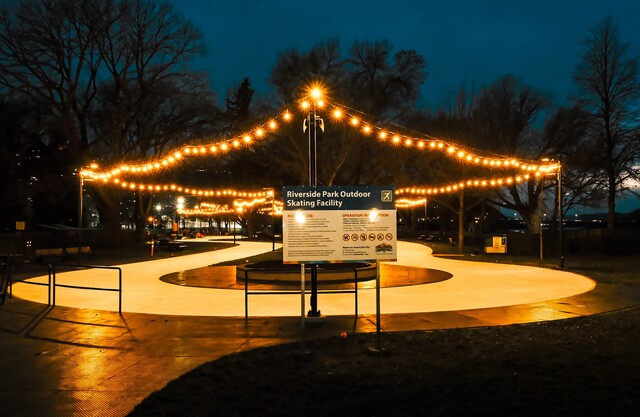
If you have been downtown lately, you have probably noticed that the new outdoor ice rink in Riverside Park has quickly become a hub of activity. While it might be easy to attribute the rink’s popularity to novelty, winter fun, or free skating, I think something deeper is at play. I think its success points to a desire in Kamloops for more third spaces.
The concept of third spaces was introduced by Ray Oldenburg, an American sociologist, to describe places outside of the home (the first place), and the workplace (the second place) (Jeffres et al., 2009). Third spaces are where people gather informally to connect with others and feel part of a community (Jeffres et al., 2009). As Oldenburg and Brissett (1982, as cited in Jeffres et al., 2009) explain, third places help people stay “in touch with reality” by fostering personal connections beyond the routines of work and home. Beyond relationship building, sustained engagement in third places can also foster collective feelings of civic pride, trust, acceptance of diversity, and a shared sense of community (Finlay et al., 2019).
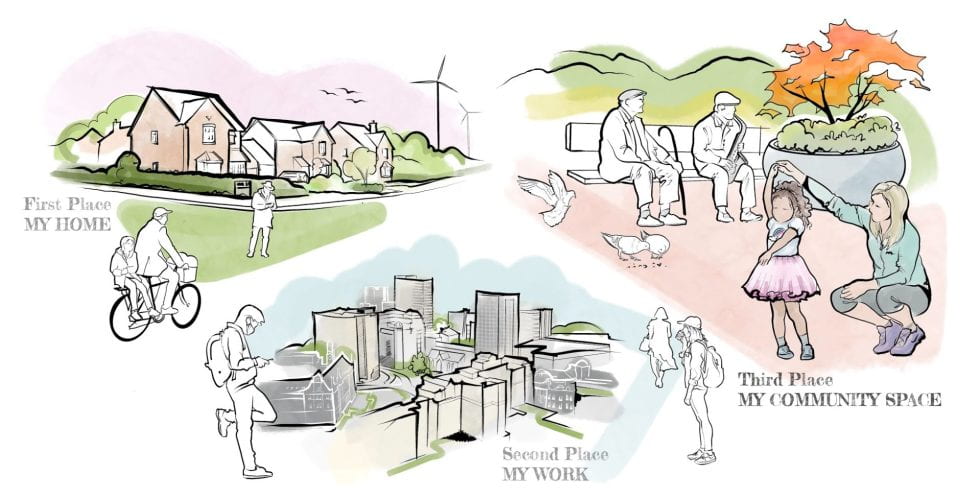
According to Oldenburg (1989, as cited in Jeffres et al., 2009), third places are defined by several core characteristics, including:
- They are neutral ground. All are welcome, and no one plays “host”;
- Conversation is the main activity. Even though the setting may be a place for exercising, or playing a game, talking is always present;
- They are accessible. There are no physical, policy, or monetary barriers to entrance;
- They are a home away from home. There are regulars who find the atmosphere comfortable enough to root themselves there;
- The atmosphere is relaxed and welcoming, allowing people to show up as themselves and feel at ease in a shared space.
Beyond these defining characteristics, Lee (n.d., as cited in Liddy, 2023) also notes that participation in third places does not depend on being outgoing or extroverted. Simply showing up and sharing space with others can interrupt isolation and foster a sense of belonging, allowing community to form through shared presence rather than performance (Lee, n.d., as cited in Liddy, 2023).

While the outdoor rink is not fully accessible to everyone, it still reflects many of the characteristics described above. It functions as neutral ground, with no membership or registration required, and draws people of different ages and backgrounds onto the ice. Conversations emerge naturally, whether between friends lacing up skates or strangers helping one another after a fall, contributing to a playful, social, and relaxed atmosphere.
The outdoor rink is also not the only space in Kamloops that reflects the qualities of a third place. For example, GameHub, where people can bring their own games and gather informally, functions as a third space for many. The Kamloops Bike Ranch is another example, as it offers a space to connect through exercise. These spaces are not perfect and still carry certain barriers, but like the rink, they invite people to simply connect with each other.
Third places also play an important role in shaping community health and wellbeing. Research indicates that neighborhoods lacking accessible, shared spaces and experiencing higher levels of social disorder are associated with poorer health outcomes, including increased stress, chronic illness, and higher mortality rates (Finlay et al., 2019). By offering low barrier environments that encourage everyday physical activity and informal social interaction, third places can help mitigate these conditions and support healthier, more connected communities (Finlay et al., 2019). Despite this, third places are frequently overlooked in community planning, even though they function as vital sites for addressing social challenges such as isolation, physical inactivity, and increasing sociopolitical polarization (Finlay et al., 2019).
The popularity of the outdoor rink makes one thing clear: people are craving places where connection can happen naturally and without barriers. If we recognize how valuable third spaces are for individual wellbeing and community health, the question becomes less about why the rink is so popular and more about why we do not have more spaces like it. Perhaps the rink is not simply a seasonal attraction, but a reminder of what our city needs more of. If we want stronger communities, we need to invest in spaces that prioritize connection over consumption. Libraries, community centers, parks, and other truly public spaces come closest to embodying the spirit of the third place. Expanding and protecting these spaces is not just about urban design, but about recognizing that human connection itself is a public good.
References
Finlay, J., Esposito, M., Kim, M. H., Gomez-Lopez, I., & Clarke, P. (2019). Closure of ‘third places’? Exploring potential consequences for collective health and wellbeing. Health & place, 60. https://doi.org/10.1016/j.healthplace.2019.102225
Jeffres, L., Bracken, C., Jian, G. & Casey, M. (2009). The impact of third places on community quality of life. Applied Research Quality Life, 4, 333–345. https://doi.org/10.1007/s11482-009-9084-8
Liddy, K. (2023). Do you have a ‘third place?’ Here’s why finding one is key for your well-being. https://www.today.com/life/inspiration/third-place-meaning-rcna94279